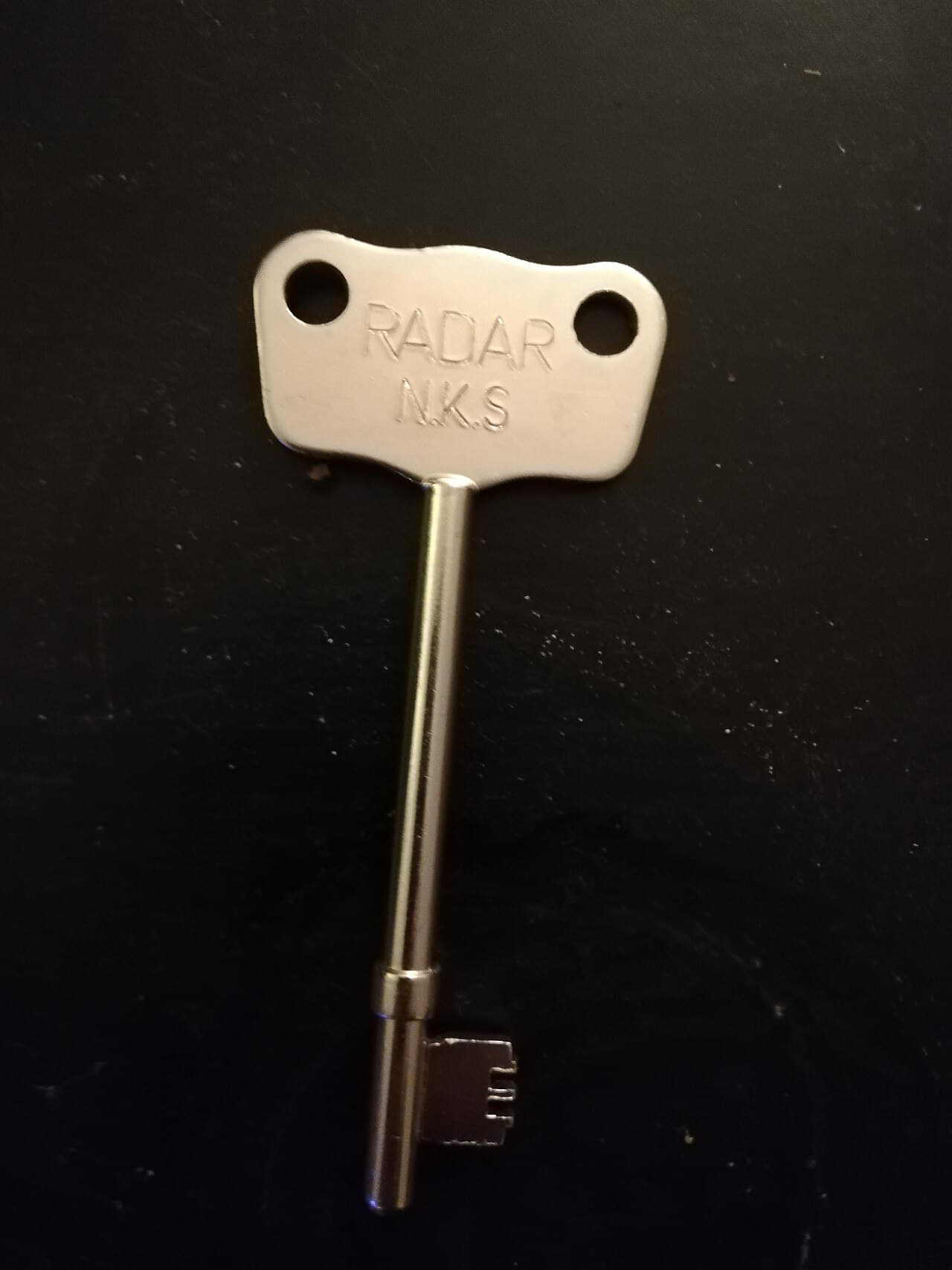
How to Get a RADAR Key in the UK — Cost, Eligibility and Where to Buy
By Daniel Wyd5 min readAccessibility & Health
The National Key Scheme gives access to over 9,000 locked accessible toilets across the UK, according to Disability Rights UK, which has stewarded the scheme since the Royal Association for Disability and Rehabilitation merged into it in 2012. The scheme launched in 1981.
The most common question about these keys — do you need to prove you are disabled? — is answered wrongly almost everywhere online. This guide sets out what is actually required, what a key costs from each seller, and how to tell a genuine key from a copy that will not turn.
Do You Need Proof of Disability to Get a RADAR Key?
There is no law requiring proof. No statute makes it an offence to buy or hold a key, and there is no national licensing or eligibility test. Any proof requirement you encounter is set by the individual seller, not by legislation.
That is why the advice you see online contradicts itself — because the sellers genuinely differ:
- Disability Rights UK sells to people who need accessible facilities because of a disability or health condition. Buying VAT-free involves a self-declaration, not submitting medical documents.
- Bracknell Town Council requires a Blue Badge, GP letter or hospital letter.
- Rochdale Borough Council requires no evidence at all.
- Tameside Council also requires no proof.
- Carmarthenshire County Council requires evidence.
A VAT-relief declaration is a tax statement about eligibility and personal use. It is not a disability licence, and organisations such as care homes must pay the VAT.
What a RADAR Key Costs
There is no national price. Each council and outlet sets its own, and the range is wide. Prices verified in August 2026:
- Disability Rights UK — £5 VAT-free for an eligible individual, or £6 including VAT, plus a postage contribution
- Rochdale Borough Council — £3.50, no evidence required
- Tameside Council — £3.50 refundable deposit, no proof required
- Bracknell Town Council — £4.50, proof required
- Carmarthenshire County Council — £4.70 VAT-free, evidence required
- Colostomy UK — two keys for £4, with a prescription or recent delivery note
If your own council supplies them, it is often the cheapest route. Check its website before buying elsewhere.
How to Get One — Step by Step
- Check your local council first. Search your council name plus "RADAR key". Councils frequently charge less than national retailers and some ask for nothing but your address.
- If your council requires evidence, a Blue Badge, GP letter or hospital letter is normally accepted. If you have none of these, use a seller that does not ask — Disability Rights UK relies on self-declaration.
- Order the key, declaring VAT relief if you are buying as an individual for personal use.
- Check the key when it arrives using the authenticity tests below before you rely on it.
- Test it locally on a toilet you can reach easily, rather than discovering a fault when you urgently need it.
How to Spot a Genuine Key
Cheap copies are widely sold and often will not turn the lock. Disability Rights UK warns about them directly. Check for:
- The N&C Phlexicare logo stamped on the key. The official manufacturer states this is the mark of a key made and tested to work with its locks. This is the strongest single test.
- A five-lever mortice key, not a cheaper three-lever copy.
- The blue, heart-shaped head on the current easy-grip version — though a genuine standard-head version also exists, so its absence alone does not prove a fake.
The words "RADAR" or "NKS" printed on a listing prove nothing. Only the manufacturer's mark does.
How Many Toilets Does It Actually Open?
You will see both "9,000" and "10,000+" quoted. They measure different things. Disability Rights UK states over 9,000 accessible toilets. The manufacturer separately reports 10,000+ locks and padlocks in use — a lock count that can include gates and other facilities, not just toilets.
The honest figure for toilets is over 9,000.
Where Locked Accessible Toilets Are Found
Scheme toilets are concentrated in places that stay open when staff are not present — council-run blocks, car parks, parks, and service stations. Accessible toilets inside shops, cafés and restaurants are usually not on the scheme, because staff are there to open them.
That distinction matters: if a business keeps its accessible toilet locked with its own key rather than an NKS lock, your key will not work and you will have to ask.
Key Resources
- Disability Rights UK: disabilityrightsuk.org — stewards the National Key Scheme, sells genuine keys from £5
- N&C Phlexicare: ncphlexicare.com — the official lock and key manufacturer
- Colostomy UK: colostomyuk.org — two keys for £4 with proof of a stoma
- Your local council — often the cheapest source, and eligibility rules vary widely
Frequently Asked Questions
Is it illegal to own a RADAR key if you are not disabled?
No. No law identified makes buying or possessing a key an offence, and there is no statutory proof-of-disability test. Sellers may impose their own eligibility rules, and Disability Rights UK sells only to people who need accessible facilities, but that is a supplier policy rather than a legal restriction.
Can I get a RADAR key for IBS or Crohn's disease?
Yes. Many sellers require no evidence at all, and those that do generally accept a GP letter. Crohn's & Colitis UK includes a key with membership. You do not need a Blue Badge or a visible disability — the scheme exists for anyone who needs accessible facilities.
Why will my RADAR key not open some accessible toilets?
Two common reasons. The toilet may not be on the National Key Scheme at all — many businesses fit their own locks and hold the only key. Or your key may be a non-genuine copy; check it carries the N&C Phlexicare mark and is a five-lever type.
Daniel Wyd
Founder and editor of ToiletNearMe, a free UK public toilet finder covering 11,693 listings. More about the site.