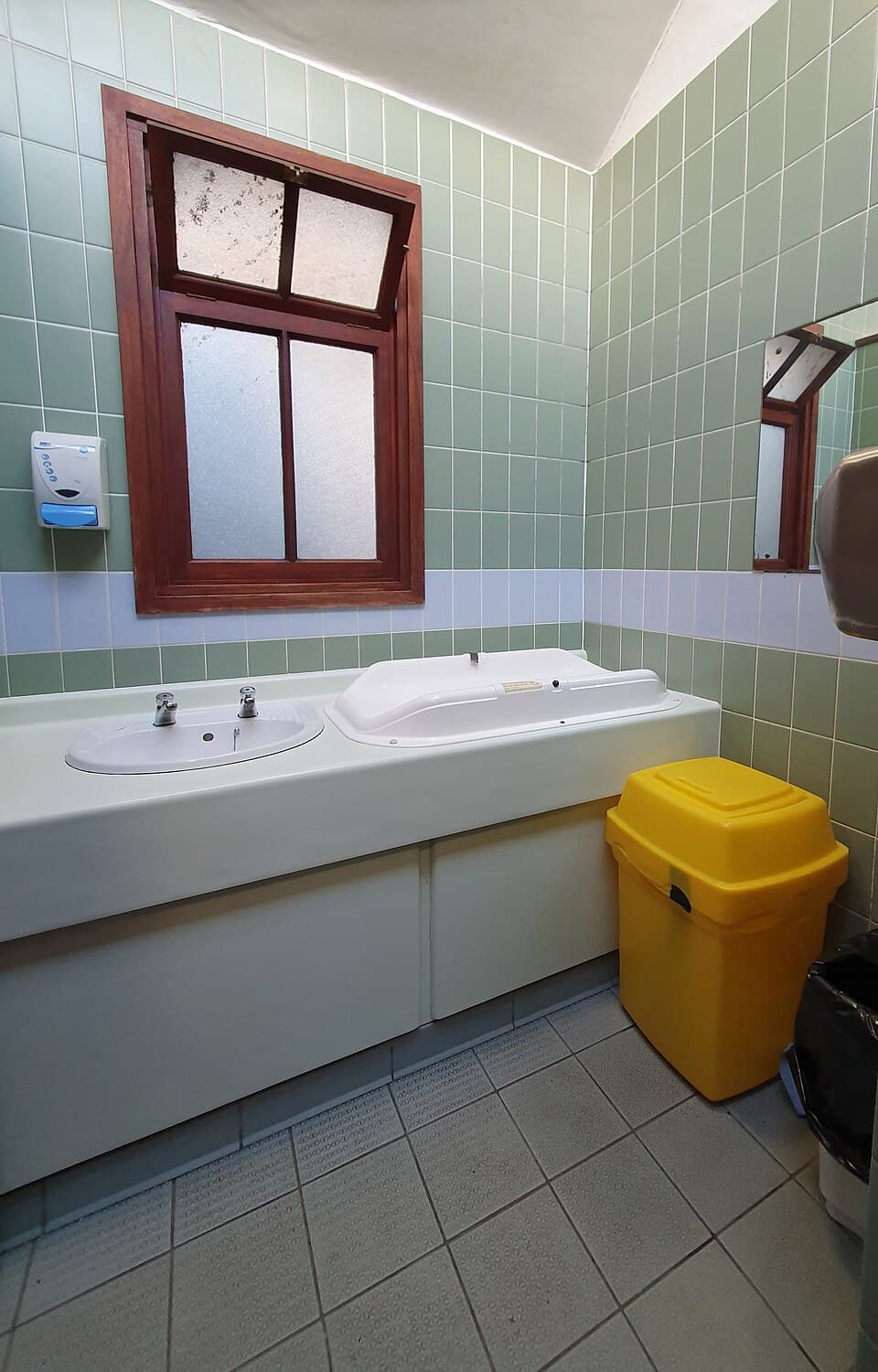
Pregnancy & Baby Changing Toilets in the UK — Rights, Facilities & Finder
By Daniel Wyd4 min readAccessibility & Health
Pregnancy significantly increases toilet urgency — as the uterus grows, it puts pressure on the bladder, increasing urge frequency particularly in the first and third trimesters. Yet the UK has no universal legal requirement for public businesses to provide toilets or baby changing facilities to non-customers. This guide explains what your rights actually are, what tools help, and how to find the nearest suitable facilities wherever you are.
Use the baby changing finder to locate the nearest facility near you, or search by your location for all nearby toilets.
Is Baby Changing a Legal Requirement in the UK?
The short answer is: no — for most existing buildings. There is no blanket legal requirement for businesses to provide baby changing facilities. However:
- For new buildings and major renovations, Approved Document M (Volume 2) guidance advises providing unisex baby changing facilities
- The British Toilet Association recommends at least 1 unisex baby changing facility per 10,000 people using the area
- The 2024 Building (Amendment) (England) Regulations updated toilet provision requirements for new non-residential buildings — but does not create a universal mandate for baby changing in existing premises
- A 2019 parliamentary petition to make baby changing mandatory in all public places was presented but not enacted
The good news: most large shopping centres, supermarkets, leisure venues, and transport hubs now provide baby changing as standard — either from customer expectation or insurance and customer-service reasons.
The Baby Changing Inequality Problem
Campaigners note that baby changing tables are frequently placed only in female toilets — effectively excluding fathers, single fathers, and non-binary parents from changing their babies. The 2024 Building Regulations guidance specifically addresses this, recommending unisex baby changing provision in new builds. If you find a venue with baby changing in women's toilets only, this is a customer feedback worth raising.
Your Rights During Pregnancy
Pregnancy is a protected characteristic under the Equality Act 2010 — one of the nine protected characteristics. This means:
- Refusing toilet access in a way that disadvantages you because you are pregnant may constitute unlawful discrimination (pregnancy and maternity discrimination, Section 18 of the Equality Act)
- This is distinct from the disability provisions — pregnancy is a separate, explicitly named protected characteristic
- The Just Can't Wait card is applicable during pregnancy and can be shown to request urgent toilet access
Employer Obligations for Pregnant Employees
If you are pregnant and working, your employer has clear obligations:
- Employers must not penalise pregnant employees for increased toilet breaks
- Employers must not apply attendance or conduct sanctions linked to pregnancy-related needs
- The Workplace (Health, Safety and Welfare) Regulations 1992 require suitable rest facilities for pregnant and breastfeeding workers
- The Working Time Regulations 1998 provide for reasonable rest breaks
Practical Tools
- Just Can't Wait card (free, Bladder & Bowel UK): Show this to request urgent toilet access at any business — applicable during pregnancy
- Great British Public Toilet Map (toiletmap.org.uk): Filter by baby changing, accessible, and other features — useful for planning days out
- Our baby changing finder: Find the nearest facility with baby changing and full accessibility details
- Open Now filter: See what's currently open near you on our Open Now map
Finding Baby Changing Facilities in UK Cities
Baby changing is reliably available at:
- All major supermarkets (Tesco, Sainsbury's, ASDA, Morrisons, Waitrose)
- Most large shopping centres and retail parks
- All major railway termini (though some are in paid toilet areas)
- Most motorway service stations
- Most museums, galleries, and visitor attractions
- Most large department stores (John Lewis, Marks & Spencer, Debenhams where still open)
Use our city-specific finders: London, Manchester, Birmingham, Leeds, and all other cities on our homepage.
Frequently Asked Questions
Can a business refuse me toilet access when I'm pregnant?
While businesses can legally refuse toilet access to non-customers, if the refusal disadvantages you specifically because you are pregnant, it may constitute pregnancy discrimination under the Equality Act 2010. The Just Can't Wait card provides a dignified way to request urgent access.
Is there a legal requirement for baby changing facilities in the UK?
No universal legal requirement exists for existing premises. New builds and major renovations are guided by Approved Document M to include unisex baby changing, and the 2024 Building Regulations update reinforces this for new non-residential buildings.
Why is baby changing only in women's toilets?
This is a common complaint. Guidance for new buildings now recommends unisex baby changing to ensure fathers and non-binary parents are not excluded. If you encounter this issue, raise it with the venue — customer feedback has driven many venues to add facilities to accessible or unisex toilets.
Daniel Wyd
Founder and editor of ToiletNearMe, a free UK public toilet finder covering 11,693 listings. More about the site.